Swachh Bharat Mission-Urban
Swachh Bharat Mission-Urban
Mission Updates


Mission Updates
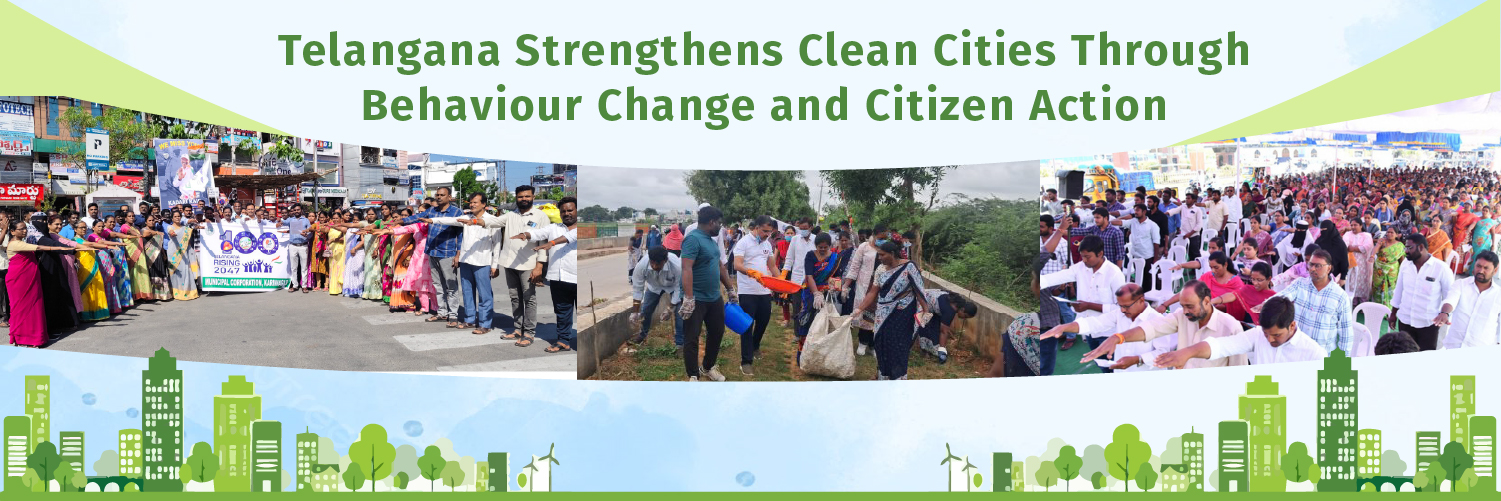
Swachh Bharat Mission stands as the world's largest behaviour change saga in the realm of sanitation — and with the launch of Swachh Bharat Mission Urban 2.0, this transformative journey has only deepened its resolve. At its core, SBM-U 2.0 has kept an unwavering focus on strengthening citizens' attitudes and practices towards responsible waste management. Driving this transformation on the ground, Information, Education and Communication (IEC) interventions have played a pivotal role in raising awareness, shifting mindsets, and fostering a genuine sense of ownership and pride towards Swachhata among urban communities. This collective shift is increasingly reflected in the visible cleanliness of cities — from cleaner streets and rejuvenated public spaces to the transformation of erstwhile garbage hotspots. Across the country, States and Urban Local Bodies (ULBs) have risen to the challenge with remarkable creativity — rolling out innovative and sustained campaigns that are not merely informing citizens, but inspiring them to become active participants in India's clean city movement.
In alignment with the objectives of SBM-U 2.0, Telangana has consistently prioritised citizen engagement and behaviour change as fundamental pillars of its urban sanitation strategy. Acknowledging that sustainable Swachhata outcomes require active community participation and attitudinal shifts at the grassroots level, the state conceptualised and implemented the100-Day Action Plan (2nd June – 10th Sep 2025) — a structured, time-bound IEC and outreach initiative spanning Urban Local Bodies across Telangana. The campaign was designed to drive measurable progress across key sanitation, environmental, and public health parameters through coordinated mobilisation efforts.
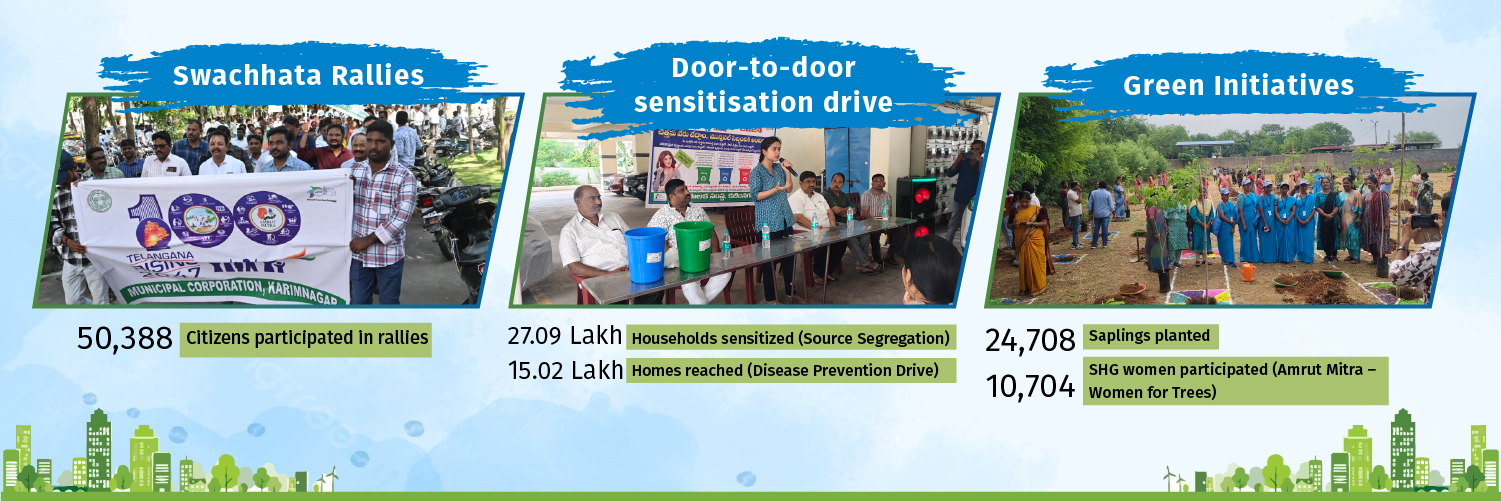
The 100-Day Action Plan was formally launched with large-scale public mobilisation, reflecting the state's resolve to build a broad-based movement for Swachhata. 36,900 citizens participated in rallies spanning 250 km, marking a strong and visible expression of community ownership at the outset of the campaign. The launch set the tone for a sustained, people-centric programme of activities across the campaign period.
A targeted door-to-door sensitisation drive was undertaken as a core component of the campaign, with a specific focus on promoting source segregation of waste and home composting practices. Under this initiative, 27.09 lakh households were sensitised across Telangana's urban areas. The outreach aimed at embedding responsible waste management behaviour at the household level — a critical step towards achieving the waste management goals envisioned under SBM-U 2.0.
In convergence with environmental objectives, the campaign implemented the ‘Amrut Mitra – Women for Trees’ initiative, under which 24,708 saplings were planted with the active participation of 10,704 women members of Self-Help Groups (SHGs) . The initiative reflects the state's approach of engaging women as active agents of environmental stewardship within urban communities. Further reinforcing this commitment, on the occasion of World Environment Day, 13,488 citizens participated in rallies covering 113 km across Telangana's ULBs, reaffirming the state's focus on a greener and sustainable urban future.
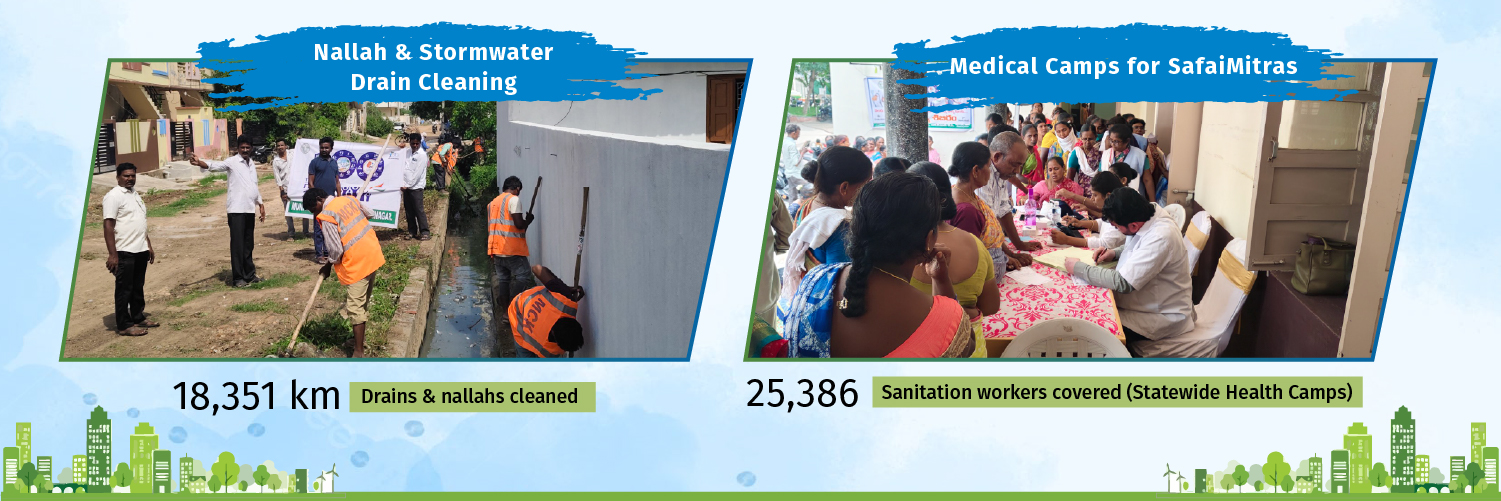
Recognising the indispensable contribution of frontline sanitation workers to urban cleanliness, the campaign included a dedicated component for the health and welfare of this workforce. 25,386 frontline sanitation staff were covered under statewide health camps, where medical check-ups and support services were administered. This initiative underlines the state's commitment to ensuring the dignity, health, and well- being of those at the forefront of urban sanitation service delivery.
As part of its focus on urban infrastructure maintenance, the campaign facilitated the cleaning of 18,351 km of stormwater drains and nallahs across Telangana. This large- scale effort is critical to mitigating urban flooding, improving drainage efficiency, and reducing the risk of waterborne and vector-borne diseases — outcomes that are directly aligned with the public health and sanitation goals of SBM-U 2.0. The campaign also incorporated a proactive public health dimension, with 15,02,819 homes sensitised across Telangana as part of a seasonal disease prevention drive. In parallel, 621 drinking water overhead tanks were cleaned across the state, contributing to the assurance of safe drinking water access for urban residents. These efforts reflect the state's integrated approach to sanitation and public health under the broader framework of SBM-U 2.0.
The 100-Day Action Plan further converged with livelihood and women's empowerment objectives through active SHG engagement. A total of ₹1,045.04 crore in loans were disbursed to 8,546 SHGs, strengthening the financial capacity of women-led collectives. SHG products were also showcased at street food festivals and melas organised as part of the campaign, generating sales worth ₹77.12 lakhs — demonstrating the potential of linking Swachhata initiatives with local economic empowerment.
Telangana’s 100-Day Action Plan stands as a strong example of structured, outcome- oriented IEC and community engagement under SBM-U 2.0. Building on this momentum, the state has launched a focused 99 Days Action Plan (March–June 2026) to deepen behaviour change and strengthen urban service delivery across sanitation, water supply, heat mitigation, citizen engagement, and governance reforms. With clear targets—from garbage-free streets and safe drinking water to robust grievance redressal and enhanced citizen participation—the initiative reflects a shift towards sustained behavioural transformation. Large-scale outreach efforts, including door-to- door awareness on source segregation and home composting covering over 6.5 lakh households, Swachhata rallies, 194 cleanliness drives, Sunday Funday activities with health camps for sanitation workers, and pledge drives engaging over 22,482 citizens, further reinforce Telangana’s citizen-led approach to building cleaner, healthier, and more accountable cities.